

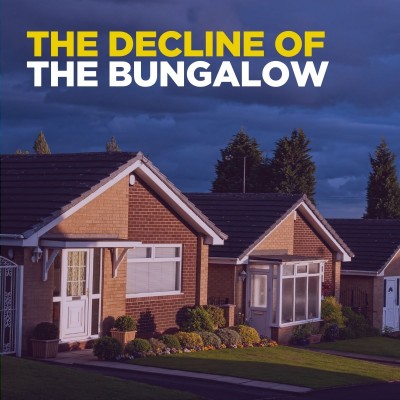
There has been a lot of talk over recent years of the growing difficulty in finding suitable properties for people requiring single-storey homes.
House hunters either compromise on the house type, plump for a less suitable two storey home, or have to look outside their preferred area. And those bungalows that are found come at a much greater price.
And really, that shouldn’t come as a surprise, the statistics have been telling consumers this for years.
Since the bungalow’s creation in 1869 by relatively unknown Architect, John Taylor, Britain’s first modern bungalow on Westgate-on-Sea, Kent, was regarded as a refreshing, “modern” change from ornate Victorian Architecture. It was not long after that the rest of the western world took note in areas such as California where the bungalow really took off and became a recognized form of residential living for families.
 More information about John Taylor's Architectural designs
The 1930s and the 1960s saw a boom in popularity for the humble bungalow throughout Britain where a significant number of new homes were single storey properties, the numbers of which would rarely be seen again.
In the 1980s, 1 in 6 “new build” properties were bungalows. By the early 2000s, this had dropped to almost 7 in every 100 new homes and data in 2020 revealed this is now down to almost 1 bungalow in every 100 new homes. Just 1,833 new bungalows were registered as complete in 2020.
And it has recently dropped again. Research indicated in November 2023 that just 226 new bungalows were registered as complete in the third quarter of 2023, revealing a 70% drop over the previous year, according to the NHBC.
In fact, bungalows are now so few and far between, that they’ve become somewhat of a “so-rare-and-retro-they-are-cool” type of comeback – according to some sources.
But, why the drop?
Bungalows in Britain have a “beige” reputation, seen as the safe, unassuming and sensible house type, rarely falling into the category as “glamourous” or “lovely” – if homes could ever really have such a reputation. That has played into the thinking of developments over the decades to accommodate trends at the time.
In addition, the powers or influences that be, have also favoured more traditional, british property styles –moving away from “forward thinking” designs of the 1950s, 60s and 70s that heavily influenced the popularity of the humble, single storey home.
For example, in 2007, the then Prince Charles, a regular architecture critic, called bungalows “homogenised boxes”, accusing them of ruining the natural beauty of the Highlands landscape. King Charles has in previous roles taken a keen interest in architecture and has had quite strong views on architecture, campaigning and torpedoing modernist developments, going as far as building his own traditional town.
His Majesty infamously scuppered modernist additions from being built at the National Gallery and the Royal Opera House, not to mention knocking back schemes from architectural heavyweights including Richard Rogers and Ludvig Mies van der Rohe to name but a few occasions.
In a nutshell then, there a various reasons why bungalows have been on the decline over recent decades, when combining both trends and those that hold power and influence in planning and design circles.
A third reason however is the cost of land.
Over the years, bungalows have progressively fallen out of favour, mainly that the powers that be and developers alike have found two or three storey homes to be a more effective use of land.
Where as at one time Architects were given free reign to work with designs and masterplanning of what ‘feels right’ along with Town Planners, where more organic developments took place, now we have the dreaded term “density calculations” – which translates roughly as “how many units can we squeeze on”.
Steve Wood, the CEO at NHBC (National House Building Council) said: “Land is a scarce resource, which developers make use of in the most efficient way possible. “On a plot for a single bungalow, it may be possible to build three or even four houses."
Local authorities have done little to discourage the sandwich housing brigade. In fact, they employ their own calculations to encourage the developer to squeeze one or two more units on a development. Afterall, the more units that are built, the more “land development contributions” are made through Section 106, or in plain English, money is donated from the profits of a developer into the local council’s coffers. In most cases, contributions have to be made on developments of more than 10 houses, so larger developments (think Barret Homes, Taylor Wimpey, Redrow and other House Builders).
Any person requiring single storey living is really at a great disadvantage, finding that bungalows are generally rare on the market, representing approximately 7.5% of the current housing stock in England.
This has resulted in bungalows attracting much higher average values compared to more traditional two storey homes. The average home in January 2023 was £290,000.00, with the average cost of a bungalow being £50,000.00 more at £340,000.00.
You’d be forgiven for thinking that bungalows are simply not appealing and less desirable – but statistics prove otherwise. Although recent articles indicate that they have seen somewhat of a renaissance in the last couple of years, the reality is that they have been highly desired for a number of years.
Demand for bungalows remains high, however developers and the local authorities alike do not see them as profitable enough to deliver.
For those with disabilities requiring a single storey home, it is more than likely that they will pay more than the average home owner if they are fortunate to find a home in their desired location.
What is being done?
In reality, very little - whilst the pressure remains to meet housing targets set by the government, there is little incentive to “lose” precious units on a development, at the cost of a developer’s profit margin and the local authority’ target contributions / housing targets. One really feeds the other.
There is some pressure to change this in the media today, such as the article written by Ross Clark of the Telegraph who has stated that planners should be insisting that a certain proportion of new homes are single storey.
In reality, radical change needs to be made both to the planning system and to way developments are considered in their entirety.
So long as the present system remains in place, little improvement will be made with regards to alleviating pressures for those requiring single storey accommodation.
For more information, contact us on
01484 960560 or email us +


Related News +

If you would like to know more about our work, please contact us +


Copyright 2026 © France+Associates | All Rights Reserved. Made By Aim.


